CASE STUDIES
- Professional Development
- Enterprise Education
- Project Based Learning
- Research
- Writing
- Presentations
Professional Development - on a cruise ship
|
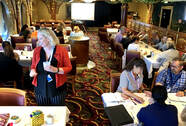
In October 2018, Think Learn Act in conjunction with Cruise Seminars ran Navigating Pedagogy, providing 15 hours of professional development for K-12 teachers aboard the cruise ship Carnival Spirit. |
Professional Development - at a school
In 2014, Shani Hartley designed and ran a course over the year based on a different theme each term:
Overall the teachers undertaking the course enjoyed the experience and most stated that their teaching had improved due to participating in the course. They particularly liked the observation process and planned to do more of it in the future as both observer and the observed.
- Term 1: What is a good teacher?
- Term 2: Engagement
- Term 3: The learning space
- Term 4: The learning process
- Observed a colleague with a focus on the particular theme
- Read the assigned academic literature on the topic
- Trialled a change in their own teaching based on the observation and readings
- Wrote a reflection about what they learned from Steps 1-3
- Met with a small group to discuss their learning
Overall the teachers undertaking the course enjoyed the experience and most stated that their teaching had improved due to participating in the course. They particularly liked the observation process and planned to do more of it in the future as both observer and the observed.
Enterprise Education
|
Think Learn Act joined forces with Sprout_Ed to conduct the Business Savvy Girls Workshop in Wagga Wagga, 23-25 January 2019. The program was designed for young women to discover and develop their passions, skills and attributes to build a business idea upon. We based it loosely on the Design Thinking model and used the Lean Canvas template for fleshing out their business concepts further. Activities included business idea prompts, creating an example of a customer (drawn, named and given characteristics) and website development. We discussed legal requirements, networking and promotional activities. The three days culminated with our participants presenting three minute business pitches at a lunch with a number of local business women who provided wonderful advice, guidance and encouragement.
|
PBL Development
At the school being assisted, studying French had traditionally involved a steady diet of rote learning and being assessed in a test at the end of the semester. There had been a steady decline in students taking up a language as an elective. To attract more students to the subject it was decided that the learning had to be more fun and relevant. Shani met with Alex, a French teacher, to help her develop a program for Project Based Learning (PBL) in Year 7 French.
First, the basic framework of PBL was outlined, as advocated by the Buck Institute of Education (BIE) in their Essential Project Design Elements Checklist. PBLWorks advocates meeting every single one of their criteria but Think Learn Act understands major changes in teaching methods need to be flexible and consider the teachers, the curriculum and the school structure and culture involved in the exercise.
Shani and Alex then brainstormed project hooks and concepts and after many wide and varied ideas were discussed, decided students would develop a resource that would make a French exchange student feel welcomed at the school and familiar with its idiosyncrasies. This concept also linked into an already established cross-curricular program that aimed to develop a sense of community for incoming Year 7 students. The overarching question to guide students in the project would be How can we make French exchange students feel welcome (at the school). Students would need to brainstorm for what they considered to be the most important aspects of the school a new student would need to know, design a resource and then research the French they would need to learn to create the resource (most likely a video, but student choice is important)
In conjunction with the PBL, it was also decided that constantly repeating French words in class wasn’t the most productive use of time for all students so flipped learning would be utilised instead. Students could then practice saying the prescribed words and phrases in their own time via supplied video clips as often as they needed, and find their own sources (with guidance) for the words beyond the basics required to create their resource. In class, time would be better spent on students working collaboratively on resource development. The project was then broken into a lesson-by-lesson structure
Finally, the assessment task was redesigned to have a formative component, to assist students in the development of the resource, as well as a summative assessment of the resource itself, to check the words and phrases learnt.
Alex and Shani were very excited by the end of their session to have a solid foundation of a more engaging and authentic learning experience that would hopefully encourage students to undertake further language study as they progressed through high school and beyond.
First, the basic framework of PBL was outlined, as advocated by the Buck Institute of Education (BIE) in their Essential Project Design Elements Checklist. PBLWorks advocates meeting every single one of their criteria but Think Learn Act understands major changes in teaching methods need to be flexible and consider the teachers, the curriculum and the school structure and culture involved in the exercise.
Shani and Alex then brainstormed project hooks and concepts and after many wide and varied ideas were discussed, decided students would develop a resource that would make a French exchange student feel welcomed at the school and familiar with its idiosyncrasies. This concept also linked into an already established cross-curricular program that aimed to develop a sense of community for incoming Year 7 students. The overarching question to guide students in the project would be How can we make French exchange students feel welcome (at the school). Students would need to brainstorm for what they considered to be the most important aspects of the school a new student would need to know, design a resource and then research the French they would need to learn to create the resource (most likely a video, but student choice is important)
In conjunction with the PBL, it was also decided that constantly repeating French words in class wasn’t the most productive use of time for all students so flipped learning would be utilised instead. Students could then practice saying the prescribed words and phrases in their own time via supplied video clips as often as they needed, and find their own sources (with guidance) for the words beyond the basics required to create their resource. In class, time would be better spent on students working collaboratively on resource development. The project was then broken into a lesson-by-lesson structure
Finally, the assessment task was redesigned to have a formative component, to assist students in the development of the resource, as well as a summative assessment of the resource itself, to check the words and phrases learnt.
Alex and Shani were very excited by the end of their session to have a solid foundation of a more engaging and authentic learning experience that would hopefully encourage students to undertake further language study as they progressed through high school and beyond.
Research
While working for Oakhill College, Shani was an integral part of the Innovative Learning Team (ILT) that researched and wrote a 60+ page report commissioned by the principal, Active Learning and ICT at Oakhill College. Out of this report, the ILT rolled out a pilot program, REAL (Relevant, Engaging, Active Learning), for Year 7 in 2014. REAL is now officially called the Oakhill Learning Framework and permeates the whole school.
To determine the effectiveness of REAL, the ILT conducted research which was later funded by the AISNSW as a two-year long project (2015-2016), culminating in the report, Keeping it REAL: How transparency can lead to an aligned curriculum, student centred pedagogy and improved student outcomes. Shani left Oakhill at the end of 2015 but still contributed to the writing of this report by conducting academic research, writing the literature review and integrating the academic research throughout the report.
To determine the effectiveness of REAL, the ILT conducted research which was later funded by the AISNSW as a two-year long project (2015-2016), culminating in the report, Keeping it REAL: How transparency can lead to an aligned curriculum, student centred pedagogy and improved student outcomes. Shani left Oakhill at the end of 2015 but still contributed to the writing of this report by conducting academic research, writing the literature review and integrating the academic research throughout the report.
Writing for Warringal Publications
Shani has written numerous articles for Busidate at Warringal Publications. Her commissioning editor, Bruce Watt, wrote the following recommendation on LinkedIn:
Shani has written many articles for me for BusiDate, a national journal for Business Studies students. Her work is always highly professional, well researched interesting. Shani brings to teaching a wealth of experience in other career fields. She is punctual in meeting deadlines, reliable and exceeds expectations.
- Hartley, S. (2017). Smiles and Giggles Across the World (Smiggle case study). BusiDate, 25(3)
- Hartley, S. (2017). Catching Fire: the case of the exploding Samsung phones. BusiDate, 25(1)
- Hartley, S. (2015). Domino’s Dominate with Digital Design. BusiDate, 23(3)
- Hartley, S. (2014). Trucking Around: A Little Look at Linfox Logistics. BusiDate, 22(1)
- Hartley, S. (2013). A Retail Revolution. BusiDate, 21(2)
- Hartley, S. (2013). Darrell Lea’s Rocky Road. BusiDate, 21(1)
- Hartley, S. (2012). Social Media in the Workplace. BusiDate, 20(4)
- Hartley, S. (2010). What Accountants Do. BusiDate, 18(2)
- Hartley, S. (2009). The Staff of Life. BusiDate, 17(3)
- Hartley, S. (2008). Business Ethics in the Global Hothouse. BusiDate, 16(1)
- Hartley, S. (2007). Monitoring Workers. BusinessDate, 15(1)
- Hartley, S. (2006). Work choices? BusinessDate, 14(1)
- Hartley, S. (2005). Social responsibilities of management. BusinessDate, 13(1)
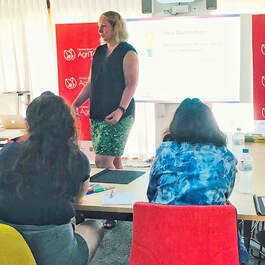
Presentation at Practical Pedagogies conference in Cologne, Germany
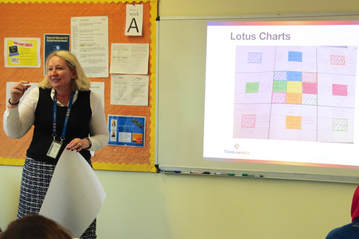
Photo courtesy of Russel Tarr, organiser of Practical Pedagogies
|
Presentation for the Economic Literacy Centre
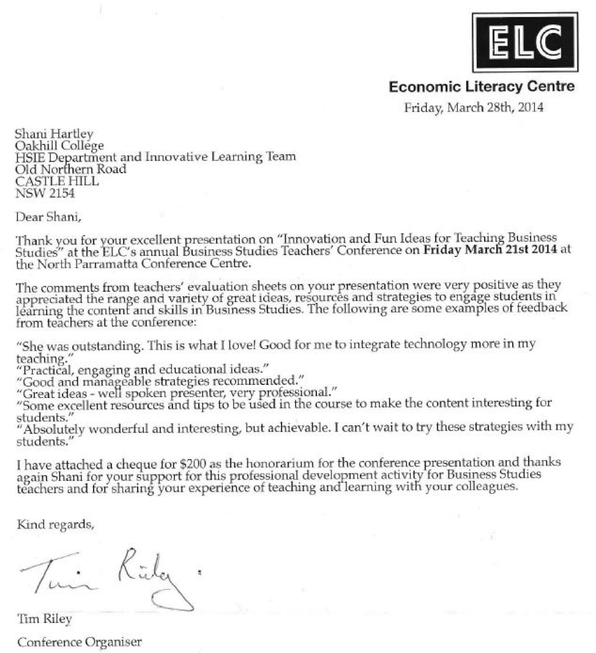
Shani presented Innovative and Fun Ways to teach Business Studies at the Economic Literacy Centre's 2014 Business Studies Teachers Conference. The slideshow is provided below. The feedback from attendees was extremely positive, as can also be seen below.